

Whiplash
A dazzling new director turns jazz into a combat sport

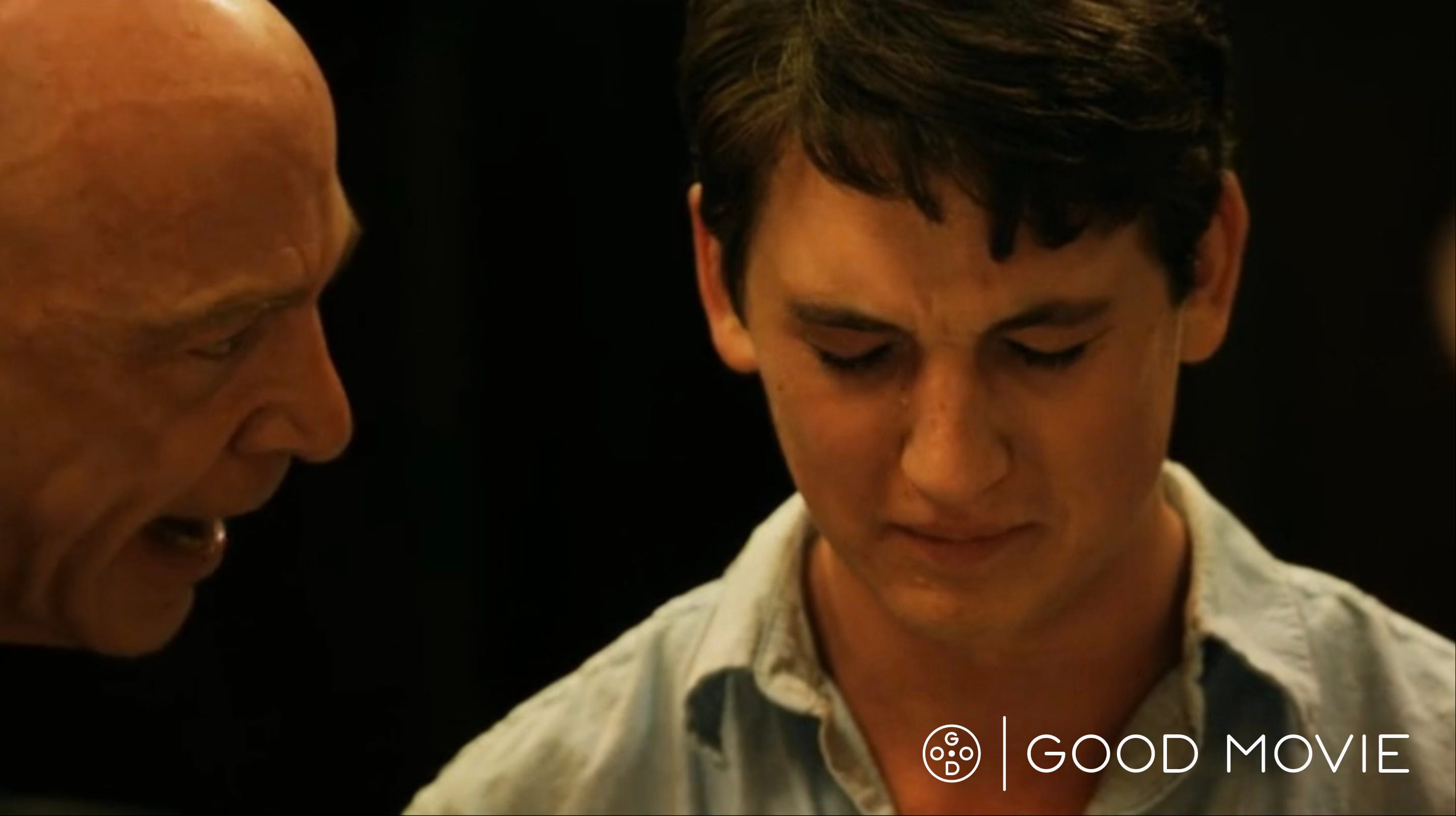
Directed By: Damien Chazelle
Other Notable Films From Chazelle: La La Land, First Man, Babylon
Starring: Miles Teller, J.K. Simmons, Melissa Benoist, Paul Reiser, jazz
Screenplay By: Damien Chazelle
Movie Synopsis: An ambitious young jazz drummer unravels under the punishing tutelage of an instructor at his prestigious music school.
Signature Line: “Not quite my tempo.”
THE INTRODUCTION
An accounting of time, and people, and context
Let’s do some Whiplash facts first, and then Whiplash’s philosophical questions second.
Some Whiplash Facts: Damien Chazelle was 28 years old when he wrote Whiplash. His agents shopped the script for six months after he completed it but they were unable to find financiers. (In December 2014, Chazelle told The Hollywood Reporter, “There is no road to the big screen for Full Metal Jacket set at Juilliard.”) Jason Reitman, whose production company would later help produce the movie, convinced Chazelle to shoot an 18-minute sequence of Whiplash as proof of concept. Chazelle did so, then submitted the cut to the Sundance Film Festival in 2013, where it won the Short Film Jury Prize. Financing was no longer an issue after that.
Chazelle secured the money to make the full version of Whiplash,1 then signed his actors (J.K. Simmons,2 Miles Teller, Melissa Benoist, Paul Reiser), then shot the entire thing in 19 days. A few months later, the movie was released, and then that next awards season, Chazelle and his producing partners and the cast were all in attendance at the 2015 Oscars, where Whiplash, a critical sensation that had been nominated in five categories,3 took home three trophies.4
Whiplash’s Philosophical Questions: Whiplash openly asks its audience a number of philosophical questions. It asks: Is being truly great at something worth the price? And it asks: Can you achieve excellence without sacrificing a piece of yourself? And it asks: Does a person become extraordinary because of the things they had to overcome or in spite of them? And it asks: What are the ethical implications of coaching someone toward realizing their innate brilliance while abusing them in the process?
But there's one philosophical question that I feel like it’s asking me directly, and that is: How willing are you to lie to yourself, Shea?
Whenever I watch Whiplash—whenever I see Neiman’s readiness to sprint toward insanity in pursuit of a quote-unquote “greatness”—there's a small (but undeniable) part of me that says, “Yes. Fuck yes. If I was in Neiman’s position, I would do the exact same thing. I would sacrifice it all to be great. If I’d have had a Terence Fletcher when I was younger, I could’ve accomplished anything. I could’ve been in the NBA, or gone to the moon, or become the greatest trumpet player to have ever lived. I would have thrived under Terence Fletcher’s vicious tutelage. That's what I know about myself. That's a thing I know in my heart to be wholly and completely and absolutely true.”
I say some version of that sentiment to myself literally every time I watch Whiplash.
But the thing is: When I really and truly and honestly think about it, I know that that’s a lie. It is absolutely a lie. If I’d have had a Terence Fletcher in my life when I was younger (or even now, for that matter), it would not have propelled me toward greatness. It would’ve crushed me. It would have destroyed me. It would’ve ruined me.
But I don’t wanna face that fact.
Because I don’t wanna admit what that would mean.
So I lie to myself about it.
Because it’s easier than the alternative—which is the whole, entire point.
THE VIEWING
A timestamped rewatch of Whiplash
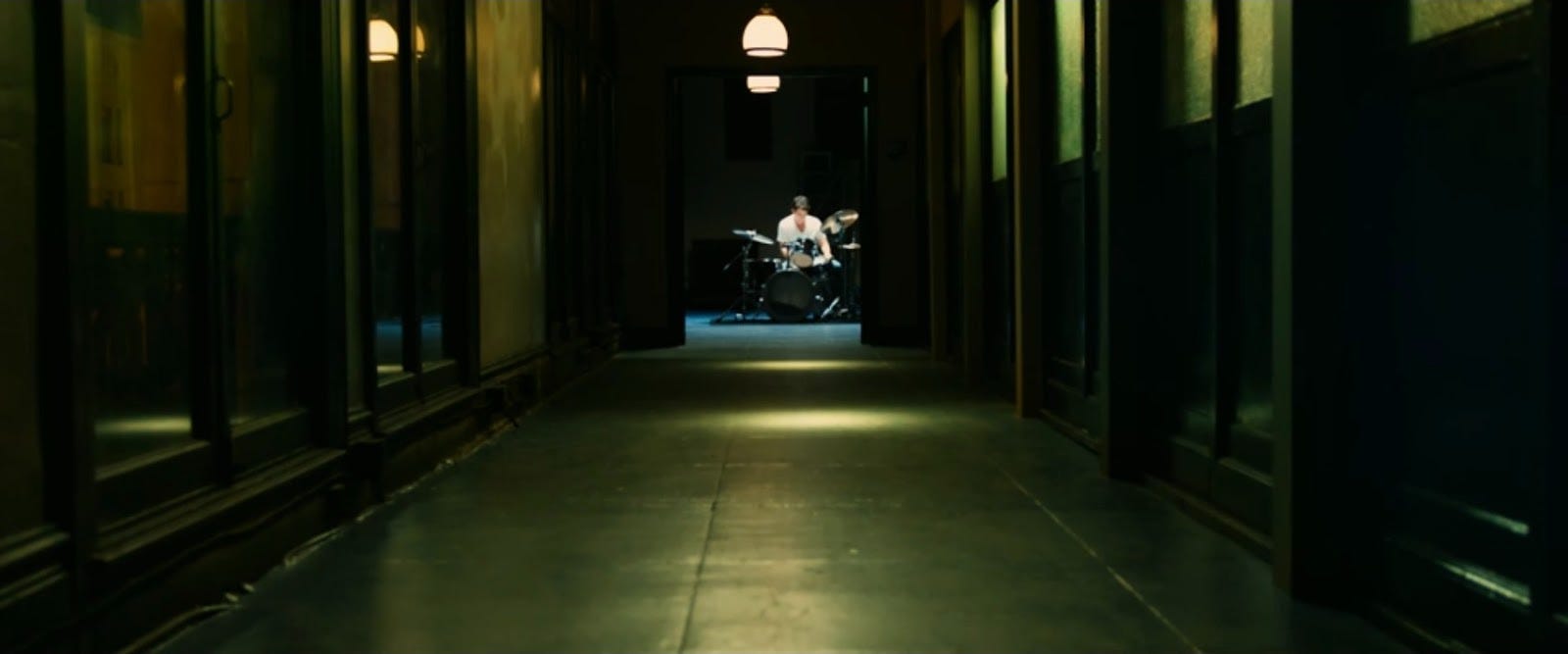
1:48: Miles Teller is here. He plays Andrew Neiman, a prodigious 19-year-old jazz drummer at Shaffer Conservatory, the best music school in the country. He’s drumming by himself in one of the campus’s practice rooms. Three things of note:
Damian Chazelle told Vulture in 2015 that he set out to pack a microcosm of the entire movie into the opening scene. “The movie was the scene,” he said. “It was the scary teacher going after the scared student. The subsequent 100 minutes of the movie are just a replay of this same scene, in different guises. I like movies that do that—establish a theme right away, then perform a series of variations on that theme. To me, it’s a very musical way of approaching storytelling.”
Teller started playing drums when he was 15. Nearly all of the drumming you see his character do in Whiplash, including in this part here, is actually Teller, not a double.
The camera’s view of Nieman starts from far away and then pushes slowly in on him as he drums. It’s a cool thing on its own, but it becomes even cooler when the camera eventually cuts to the other side of the practice room and you realize that you’ve been observing Nieman from Fletcher’s point of view. He’s like a predator stalking prey. And to that point…
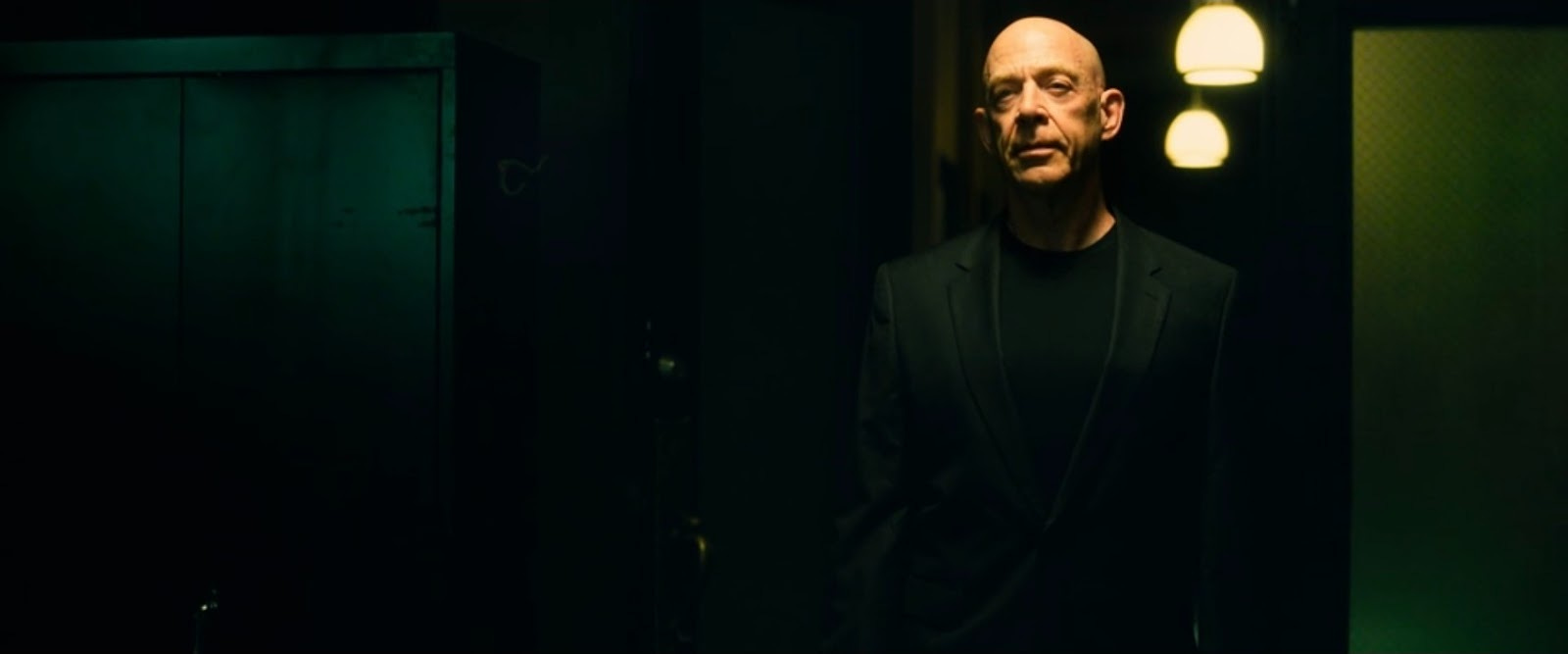
2:35: J.K. Simmons is here. He plays Terence Fletcher, the unrelenting, unforgiving, extremely unpleasant conductor of Shaffer Conservatory’s top band. We’ll come to learn that he is truly, truly awful—a bully and a bastard and a bonafide son of a bitch. We’ll also come to learn that he is utterly, utterly compelling. He’s pure electricity. And that combination—the clear danger plus the undeniable allure—is why he’s such a great villain. You’re terrified of him when he’s in the room, but when he’s not in the room you find yourself going, “Ummm… Should I feel bad that I kind of can’t wait for the horrible guy to come back?”
2:57: Neiman stops playing as soon as he notices Fletcher watching him, which leads to this great exchange:
Fletcher: Do you know who I am?
Neiman: Yes, sir.
Fletcher: So you know I’m looking for players?
Neiman: Yes, sir.
Fletcher: Then why did you stop playing?[Neiman plays a quick solo for Fletcher]
Fletcher: Did I ask you to start playing again?
Neiman: Sorry, I misunderst—
Fletcher: I asked why you stopped playing, and your version of an answer was to turn into a wind-up monkey.
These guys have known each for less than a minute and Fletcher already has Neiman in a headlock.
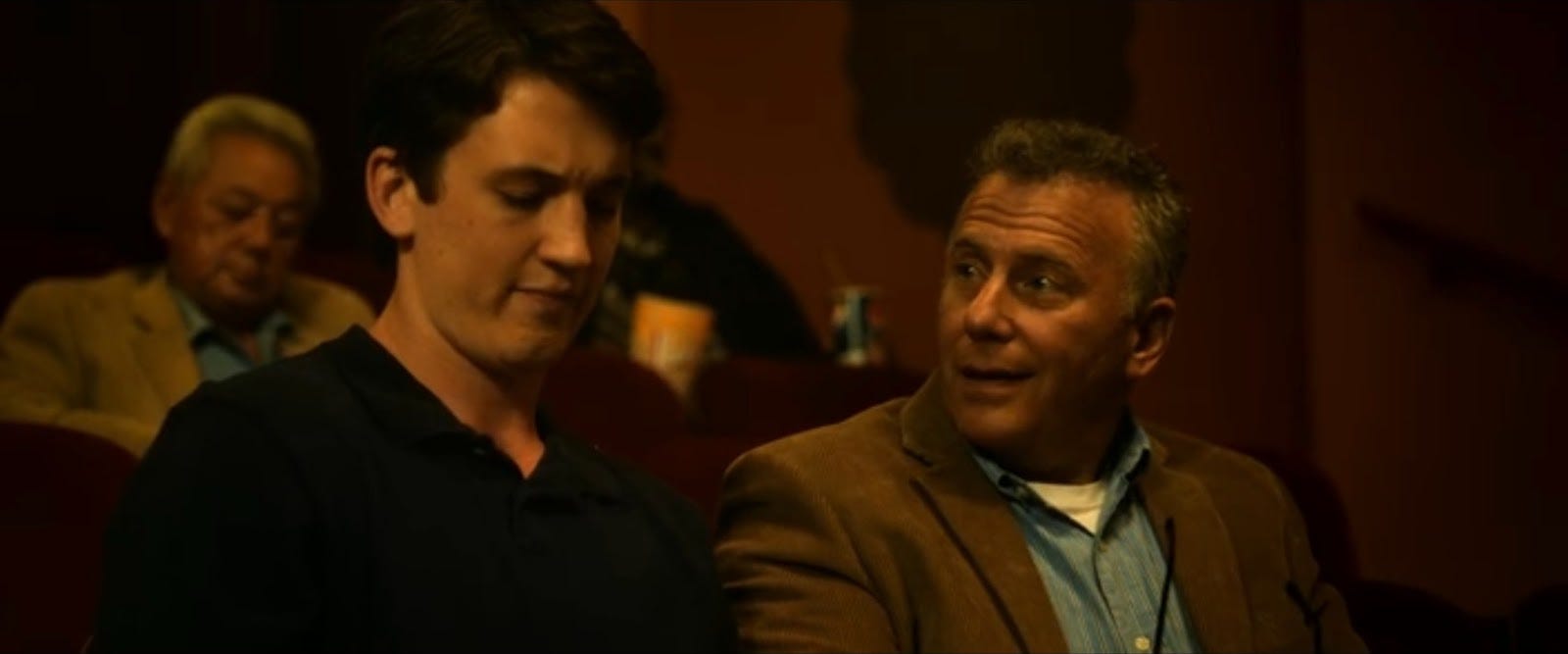
6:05: Neiman’s at the movies with his dad (Jim, played by Paul Reiser).5 Neiman’s dad notices that Neiman is a little down so he asks what’s up. Neiman tells him about the encounter with Fletcher, noting that it didn’t go that great. Rather than offer any sort of helpful advice or words of encouragement, his dad is basically like, “Ah, well. Time to give up on your dream. Lots of other jobs out there.” What a loser, this guy is. I already hate him.
6:06: (Another way to read this scene is that Neiman’s dad already knows that Fletcher is a dangerous person who will turn Neiman’s head into a bowl of spaghetti if he gets the chance. He knows that the best thing for Neiman is to be as far away from Fletcher as possible, but he also knows that his son has loved drumming since he was a child. He doesn’t wanna discourage this version of his son’s dream, but also he has to figure out a way to protect him from Fletcher. And if that's actually the case, he is not a loser. He’s just a dad who’s concerned about his child.)
8:12: I have no idea how anybody plays an instrument. It’s like magic to me. If I was alive back during the Salem Witch Trials days, I one hundred percent would’ve seen some guy playing a guitar and been like, “Guys. Guys! We gotta drown this dude ASAP.”
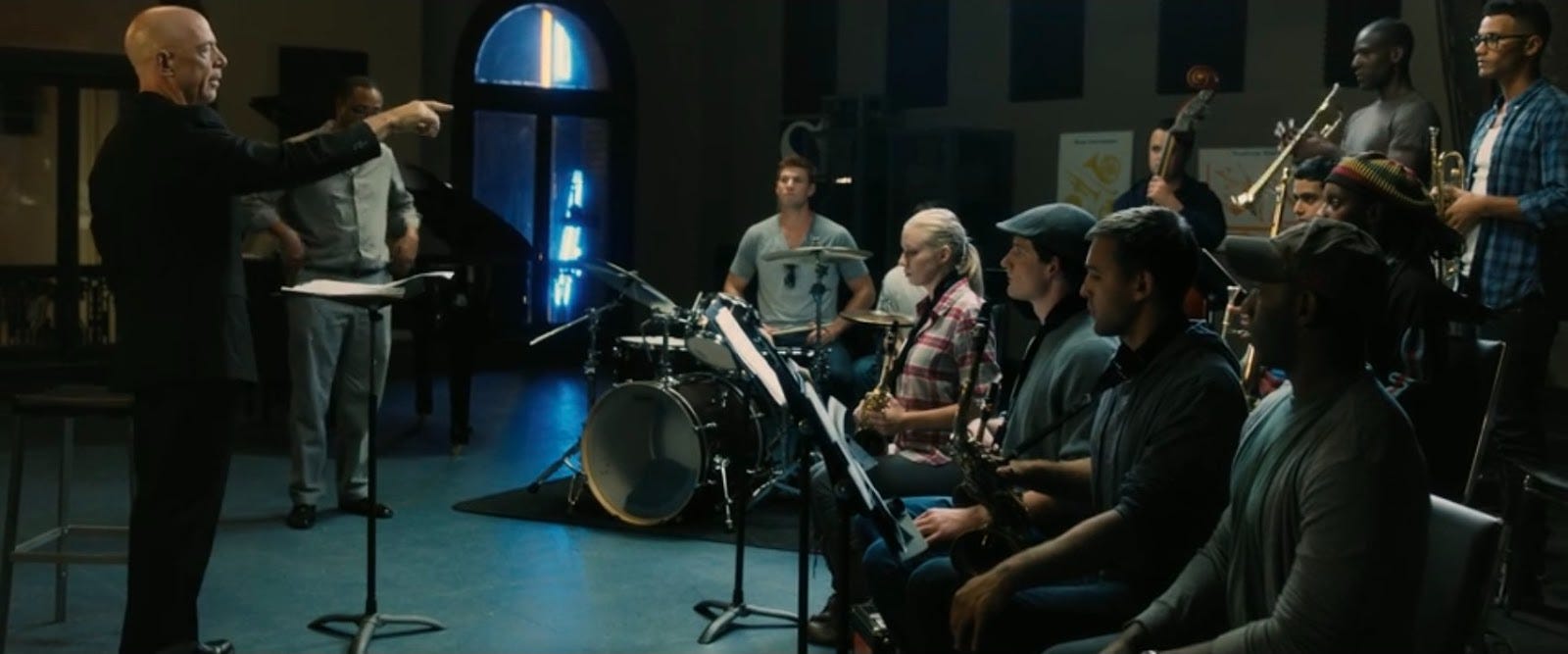
10:48: Fletcher just interrupted Neiman’s class as he looks for players he can poach for his band. He ran each of the different sections of the band through an impromptu audition. The only person Fletcher was interested in: MY BOY NEIMAN. He just got an invite to sit in with Fletcher’s highly-selective Studio band as the alternate drummer. I’m so proud.
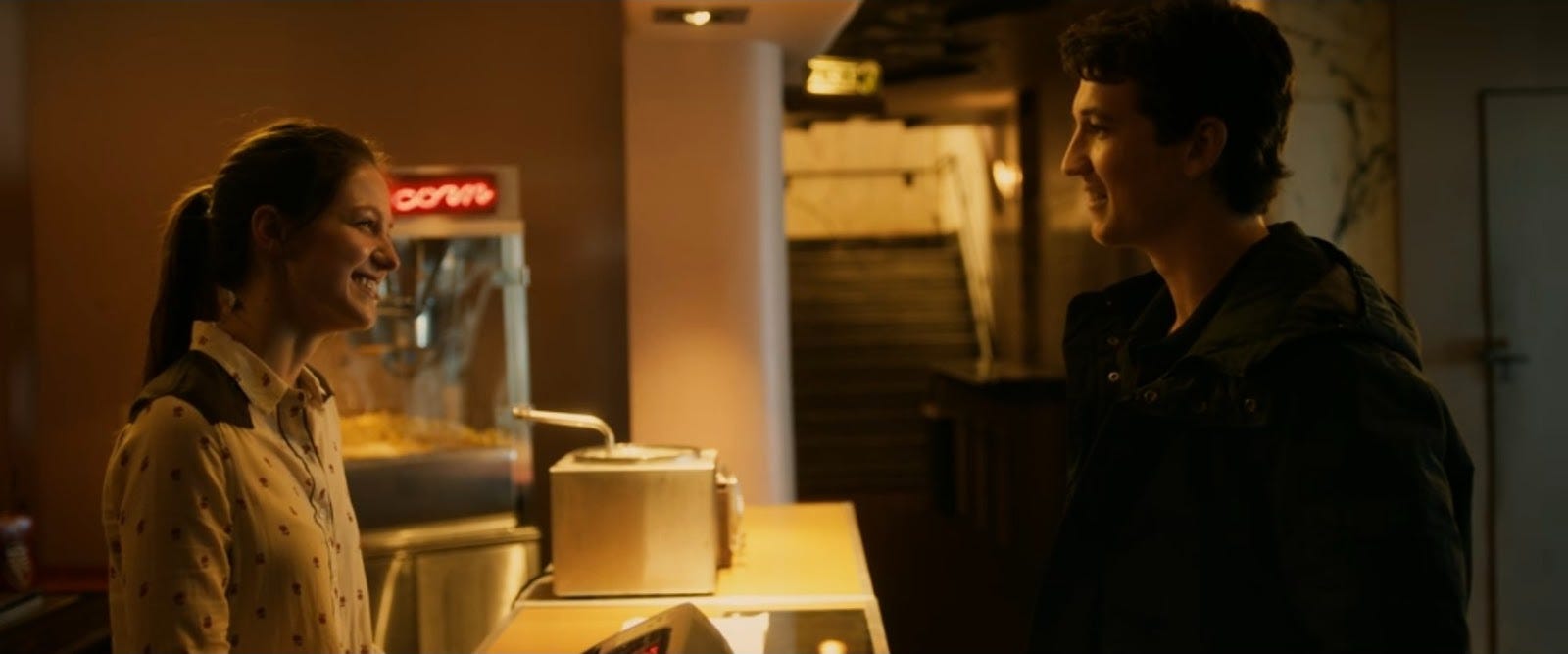
13:44: Neiman, buoyed by the confidence of having drawn Fletcher’s attention, decides to ask out his crush (Nicole, played by Melissa Benoist). This little interaction between them at the movie theater where she works is such a wonderful scene. The chemistry they have… you just instantly love them as a couple. Benoist isn’t given a ton to do with the Nicole part, but she smashes it. Someone please book her for a rom-com. Have her and Teller do La La Land 2: Take No Prisoners.
16:52: It’s Neiman’s first day with the Studio band. As they prepare for Fletcher to arrive, someone shouts “Milk the cunt!” It’s a music phrase that means “play Middle C,” as in: “Whoever is on the piano, please play the Middle C note so that everybody can get in tune.” Two things to mention:
There's gotta be a less horrible way to say that.
It would’ve been very easy for an audience to get lost in the music jargon in Whiplash, but Chazelle, who grew up playing in a competitive jazz band, has a great touch for knowing how and when to explain something without ever really explaining it. For example, as soon as the guy says “Milk the cunt,” Chazelle cuts to a close-up of someone playing a note on the piano and then a couple of shots of the other band members as they play their various instruments. You might not know precisely what the phrase means, but you’re able to put together that it has something to do with the musicians tuning their instruments.
17:05: Fletcher walks in at exactly 9AM on the dot. Like, literally as the second hand hits 9:00:00. Do you think he was just waiting outside staring at a clock? Did he have his hand on the doorknob waiting to open it like how you hold the microwave door and try to open right before the alert goes off? What a maniac.
18:00: Fletcher just introduced Neiman to the rest of the band. When they met in that opening scene, Fletcher asked Neiman his name. When Neiman said it, he pronounced it “Nay-men.” When Fletcher presents him to the others here, though, he pronounces it “Nee-men.” He calls him that for all of the rest of the movie. And never once does Neiman correct him. He’s just like, “Yep. That's how you say it. I’m Nee-men. You’re right. I said my own name wrong earlier.”
19:03: “Barker, that is not your boyfriend’s dick. Do not come early.” Fletcher just said that to someone who played a note a smidge too early while the band was practicing. Does that insult make sense? I don’t quite understand it. I mean, I get that the phrase “come early” is a double entendre, but… like… shouldn't Fletcher reference Barker’s own dick there, not his boyfriend’s dick? It’s the wrong possessive dick, right?
20:47: Uh-oh. Someone in the ensemble is out of tune. Fletcher is going section by section through the instruments, having each group play so he can hunt down the culprit. At one point, he calls for the “bones” to play. I remember the first time I saw Whiplash I was like, “Whoa. Bones. That's a cool name for a section of instruments. I bet there's some awesome backstory for why they’re called ‘bones’. Probably some old blues player from the ‘40s nicknamed Bones. Miles ‘Bones’ Guthrie or something cool like that.” But nope. It’s just a shortened version of the word “trombones.” I’m an idiot.
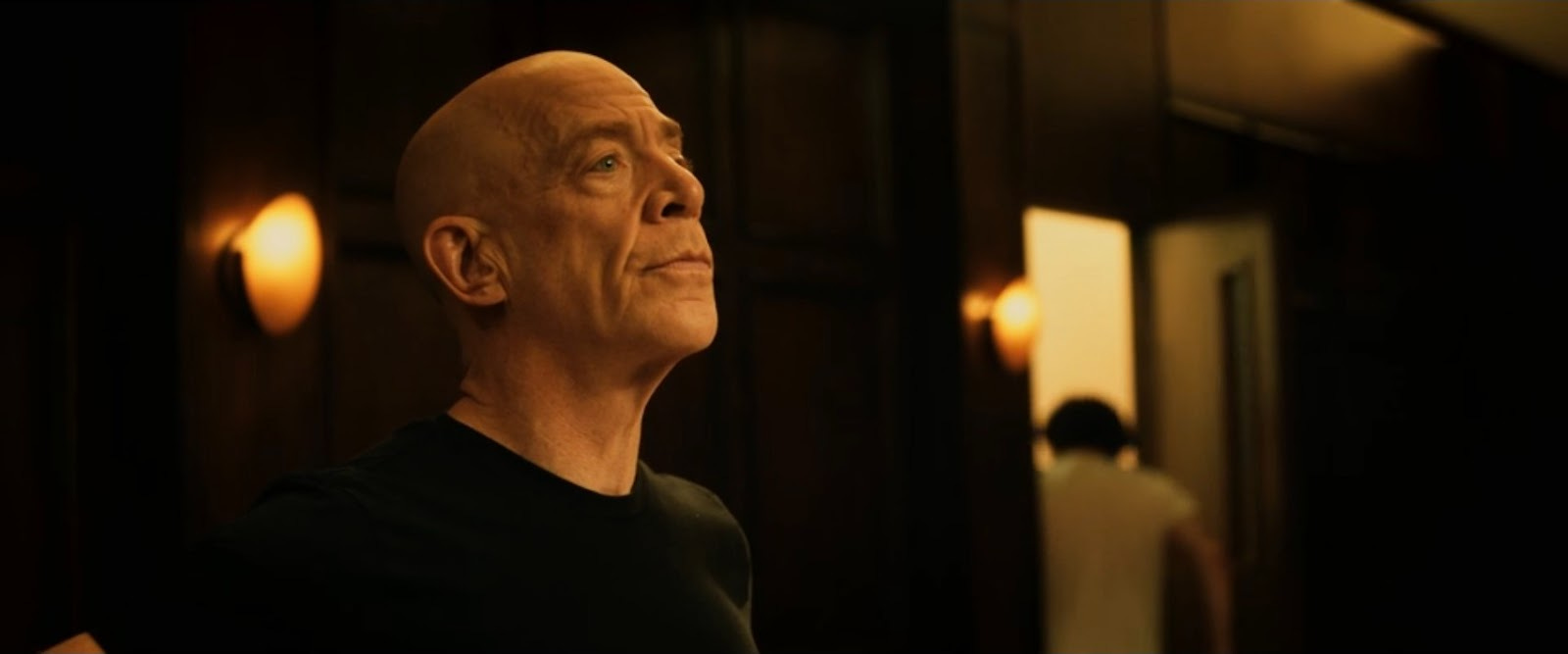
22:51: Jesus Christ. Okay, turns out, the out-of-tune player was in the trombones section. Fletcher singled out a nervous-looking kid (Metz), took a couple shots at him for being overweight, forced him to say he was out of tune in front of everyone, full-throat yelled at him, then kicked him out of the band. But then as soon as Metz left the practice room Fletcher told the others, “For the record, Metz wasn’t out of tune. You were, Erikson. But he didn’t know, and that's bad enough.” This guy’s a fucking psychopath.
You know what? Let’s actually do this scene for this week’s FOOTNOTES:
Art. Real art.
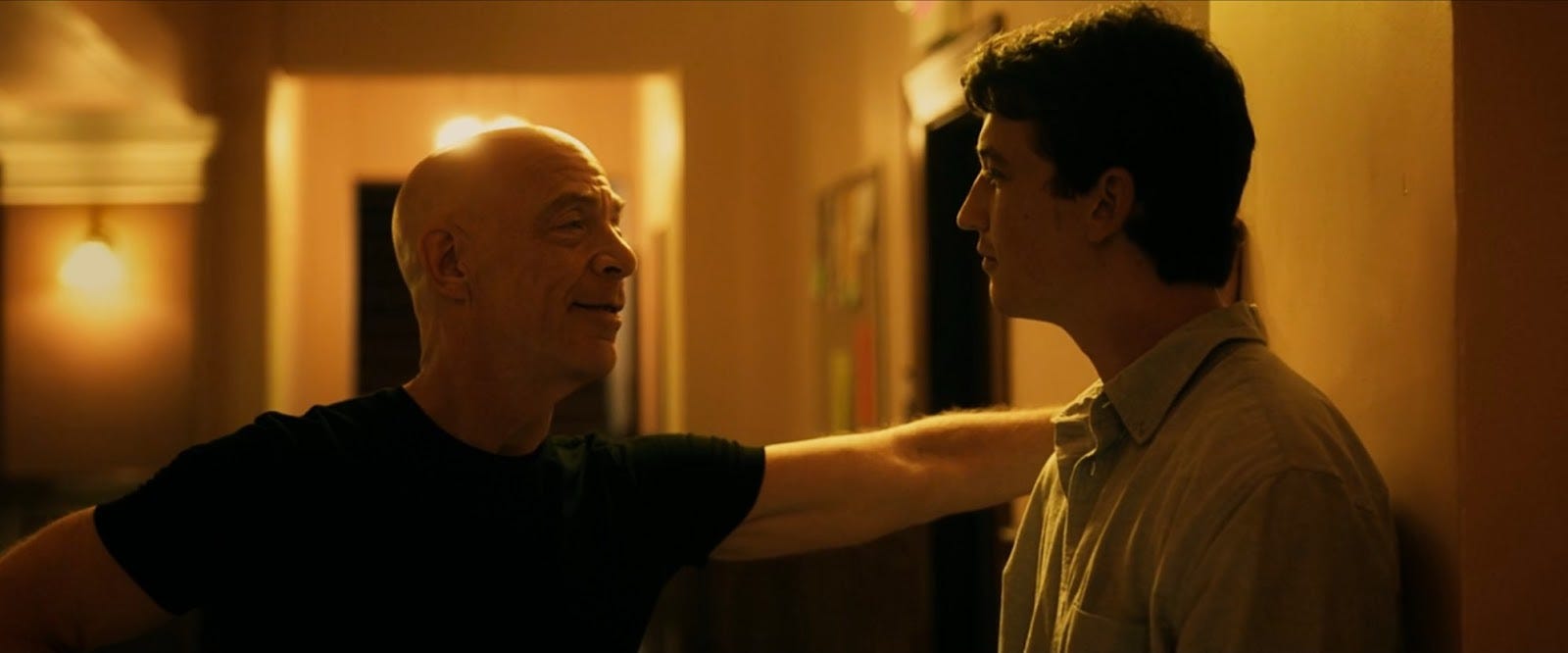
23:57: Fletcher is talking to Neiman one-on-one while the band is on a break. He’s being nice to him, but he’s doing so in that way bad guys do where it feels like each word is dipped in venom. Neiman has no idea that Fletcher is rope-a-dope-ing him. J.K. Simmons somehow plays Terence Fletcher The Jazz Teacher in Whiplash with an even more intimidating interiority than he played Vernon Schillinger The Nazi Rapist in Oz.
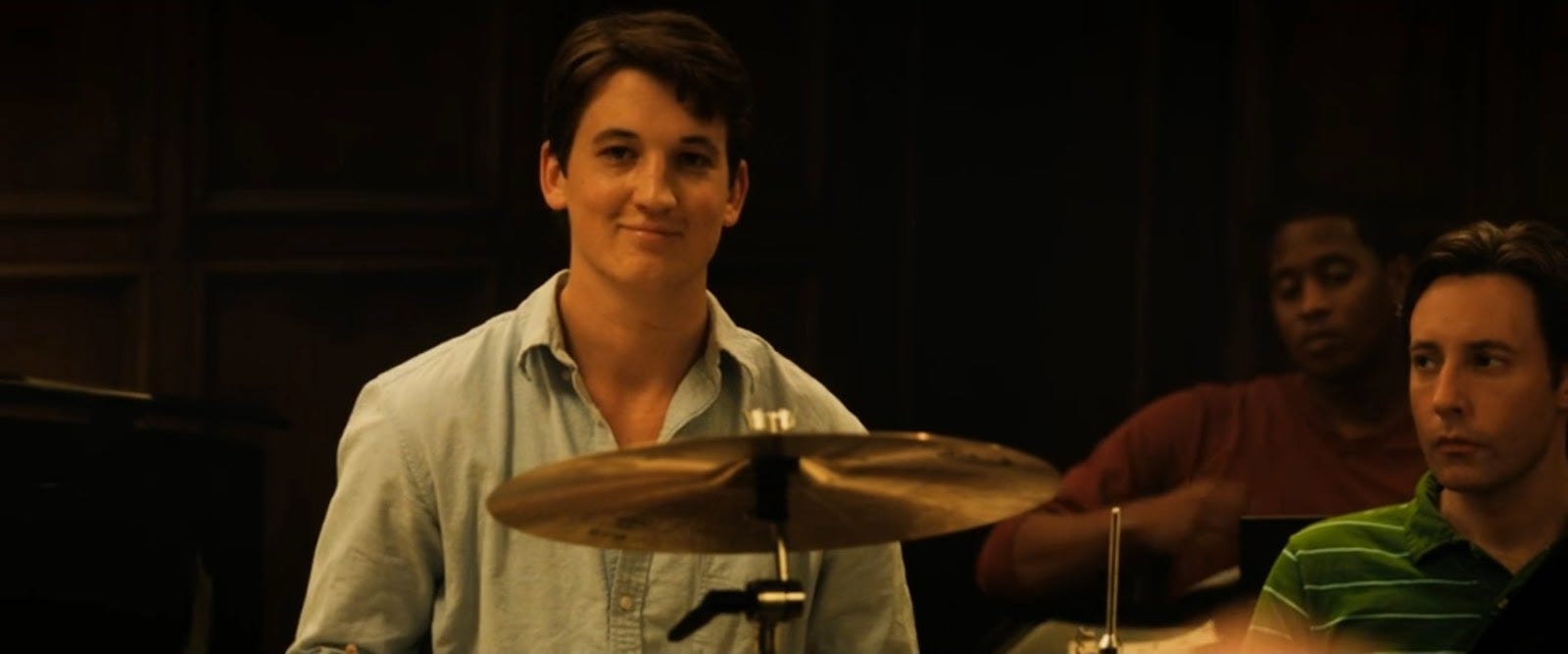
25:03: Here we go. Neiman’s about to get his first shot playing with the Studio band. Fletcher tells him to just do his best, which draws this little smile from Neiman. That's a smile that says, “Fletcher likes me. He’s taken a liking to me. Everything I’ve heard about this guy is wrong.” He’s clueless that he’s about to get hit by a truck.
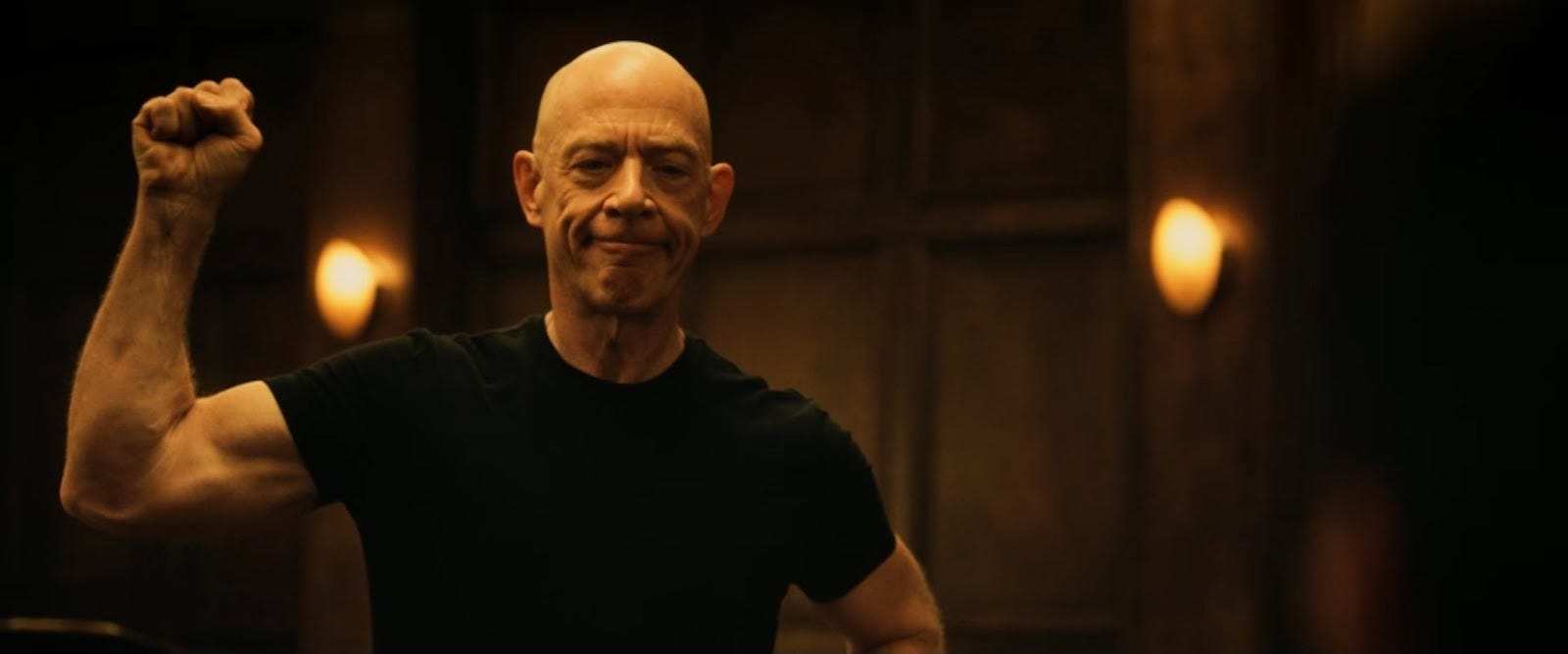
25:47: Oh fuck…
26:13: It’s starting to fall apart. Fletcher keeps having Neiman restart a certain part of the song because he can’t quite get the tempo right. Can people who are very good at music hear what’s going wrong here? Because I can’t. It all sounds pretty great to me. The only reason I know something is wrong is because Fletcher says there's something wrong.
27:20: …Aaaaaaaaaaaand Fletcher just threw a chair at Neiman’s head. We went from that safe little smile to abject terror in just over two minutes.
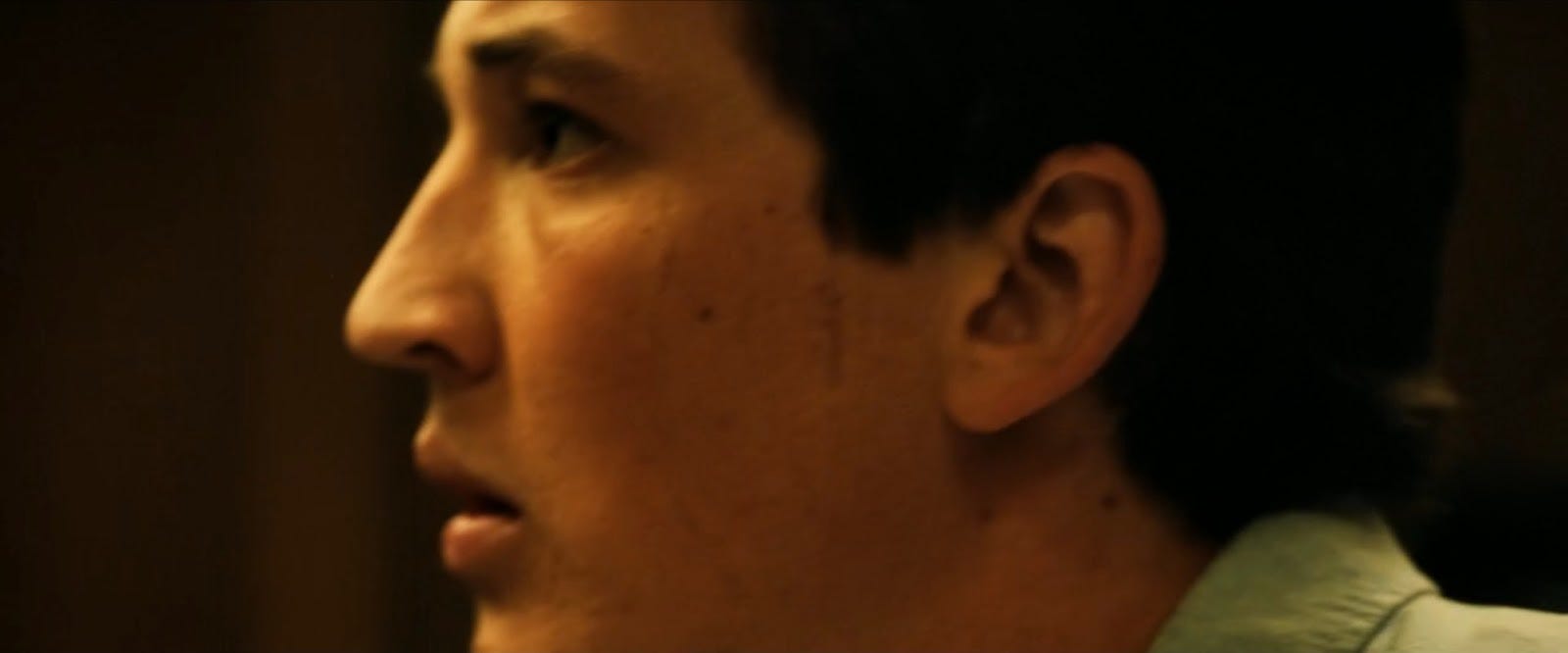
27:43: Gah. The “Were you rushing or were you dragging” scene. An absolute blitz of a moment. My favorite parts:
