

Moneyball
Turns out, math is super fun


Directed By: Bennett Miller
Other Notable Films From Miller: Capote, Foxcatcher
Starring: Brad Pitt, Jonah Hill, Philip Seymour Hoffman
Screenplay By: Steven Zaillian and Aaron Sorkin
Movie Synopsis: The general manager of the Oakland Athletics attempts to change the way his team is run and revolutionizes professional baseball in the process.
Signature Line: “How can you not be romantic about baseball?”
THE INTRODUCTION
An accounting of time, and people, and context
Montages are a staple of the sports movie genre, most often used to mark the point when things are finally beginning to come together for a group of beleaguered athletes. A shoot-first point guard throws a pass that leads to an unexpected assist, a previously egotistical linebacker makes a selfless gesture, a stubborn pitcher finally decides to buy into whatever unorthodox training regime a new coach has; things like that.
But the montage in Moneyball is different.
Rather than it being clips of players making plays, it’s clips of a general manager and his right-hand man talking with players about variances in complex sets of numbers. They discuss the inefficiency of bunting, and the maximized value of collecting easy outs that are typically overlooked, and increasing on-base percentage ratings by tenths of a point to create numerical eventualities that benefit the team. And that should be a total fucking bore. But it’s not. In fact, it’s mesmerizing.
Because Moneyball, fundamentally, is different.
It’s a baseball movie, sure. But, to steal an idea from the film itself, the aggregate is something bigger. It’s a movie about innovation, and vulnerability, and regret, and the unquantifiable magic of sports as a pastime. And it is told beautifully, a millimeter-perfect blend of Hollywood imagination and real-life footage.
That’s how something as seemingly dull as two guys being very invested in Microsoft Excel spreadsheets became a critical darling (there’s a whole separate Wikipedia page just for all of the accolades it received, including six[!!!] Oscar nominations), a commercial success (it more than doubled its budget at the box office), and a cultural touchstone (even the famously particular Quentin Tarantino included it on his list of 20 favorite films of the 21st century).
How can you not be romantic about baseball?
THE VIEWING
A timestamped rewatch of Moneyball

3:29: Brad Pitt is here. He plays Billy Beane, the general manager of the Oakland Athletics and one-half of the duo that upends the way a baseball player’s value to his team is measured. The way that I know Moneyball is a really great movie is because there is nothing less interesting to me than the intricacies of Major League Baseball team payrolls, and yet I am absolutely transfixed by precisely that any time I watch Moneyball. It’s like how I feel about mortgage rates and The Big Short or casual racism and Rush Hour 2.

4:44: Remember how Coach Eric Taylor would ride around in Friday Night Lights just being cool and handsome in a hat and sunglasses listening to people talking about his team on the radio? That’s a play you can run 100 different times in 100 different movies or TV shows, and I’m gonna love it every time.

6:20: I don’t follow baseball. And because I don’t follow baseball, I went into this movie not really knowing anything about the Oakland Athletics, or Billy Beane, or even the team’s win streak. That being said, I was 100 percent sure that Moneyball was not going to end with the Athletics winning a World Series because Brad Pitt had the same haircut in it that he had in Meet Joe Black, which I assumed was a bad sign.1
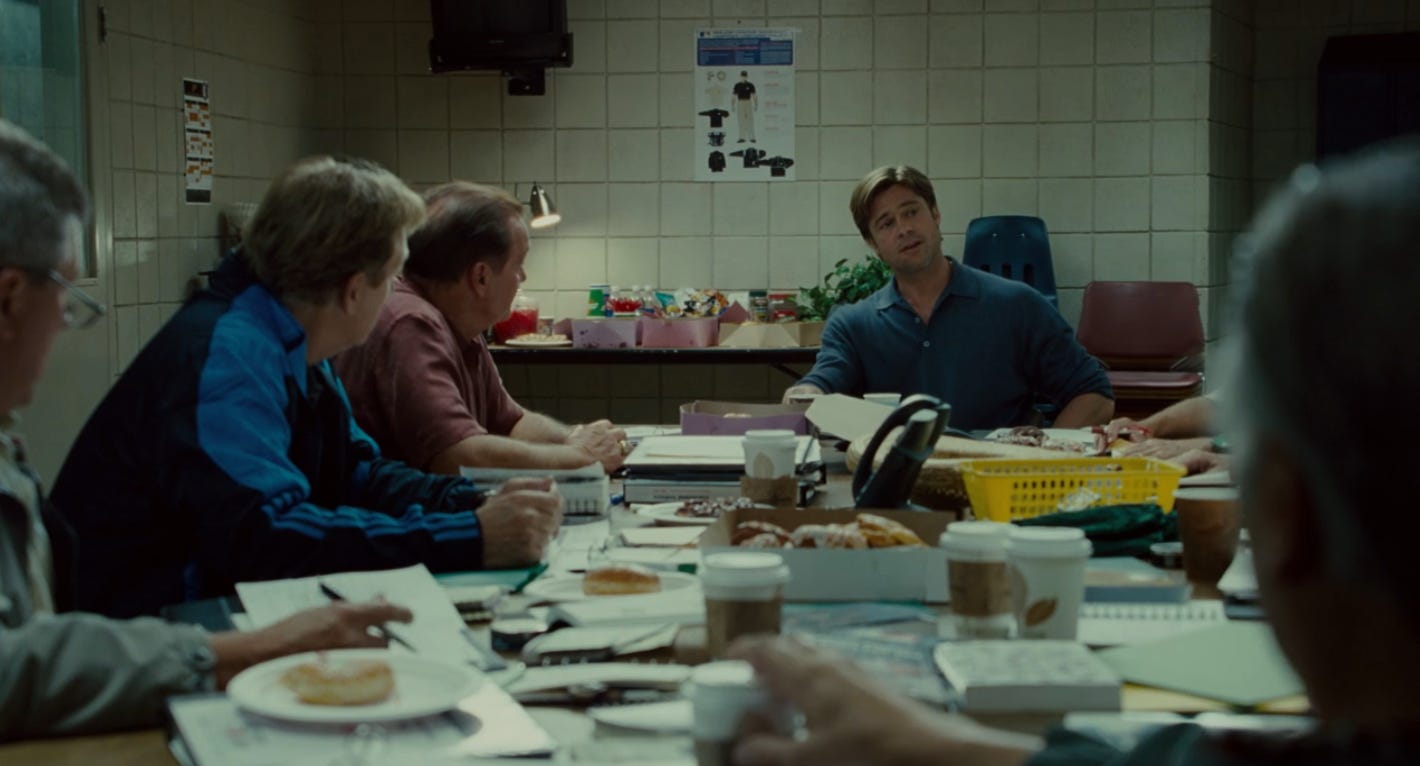
9:03: The three most important parts from the scene where Billy is in the war room with his team of scouts trying to figure out what new players the Athletics should sign:
When one of the scouts tries to convince Billy that a prospect is a good hitter because his swing is pretty, Billy balks, “If he’s a good hitter, why doesn’t he hit good?” I fucking love Aaron Sorkin so much. Nobody is better at turning dialogue into a combat sport than him.
When one of the scouts is trying to explain why he doesn’t like a certain player, he says, “He’s got an ugly girlfriend. Ugly girlfriend means no confidence.” It’s my favorite line in the whole movie, in part because I love how quickly it captures the way so many people think. I’ve had several people completely change the way that they talk to or about me after they meet Larami. She’s just such a stunningly beautiful woman that it’s impossible not to meet her, think about the fact that she chose me to be her husband, then go, “Whoa. There must be something special about that guy.” And to that point…
Time and time again, the scouts around the table bring up whether or not a player is handsome when deciding if he’s worth taking a flier on. I had no idea that baseball scouting involved so much discussion about how hot dudes are. Turns out, I would’ve been an excellent scout. I’d have known Javier Baez was gonna be a star before I even saw him swing a bat once.
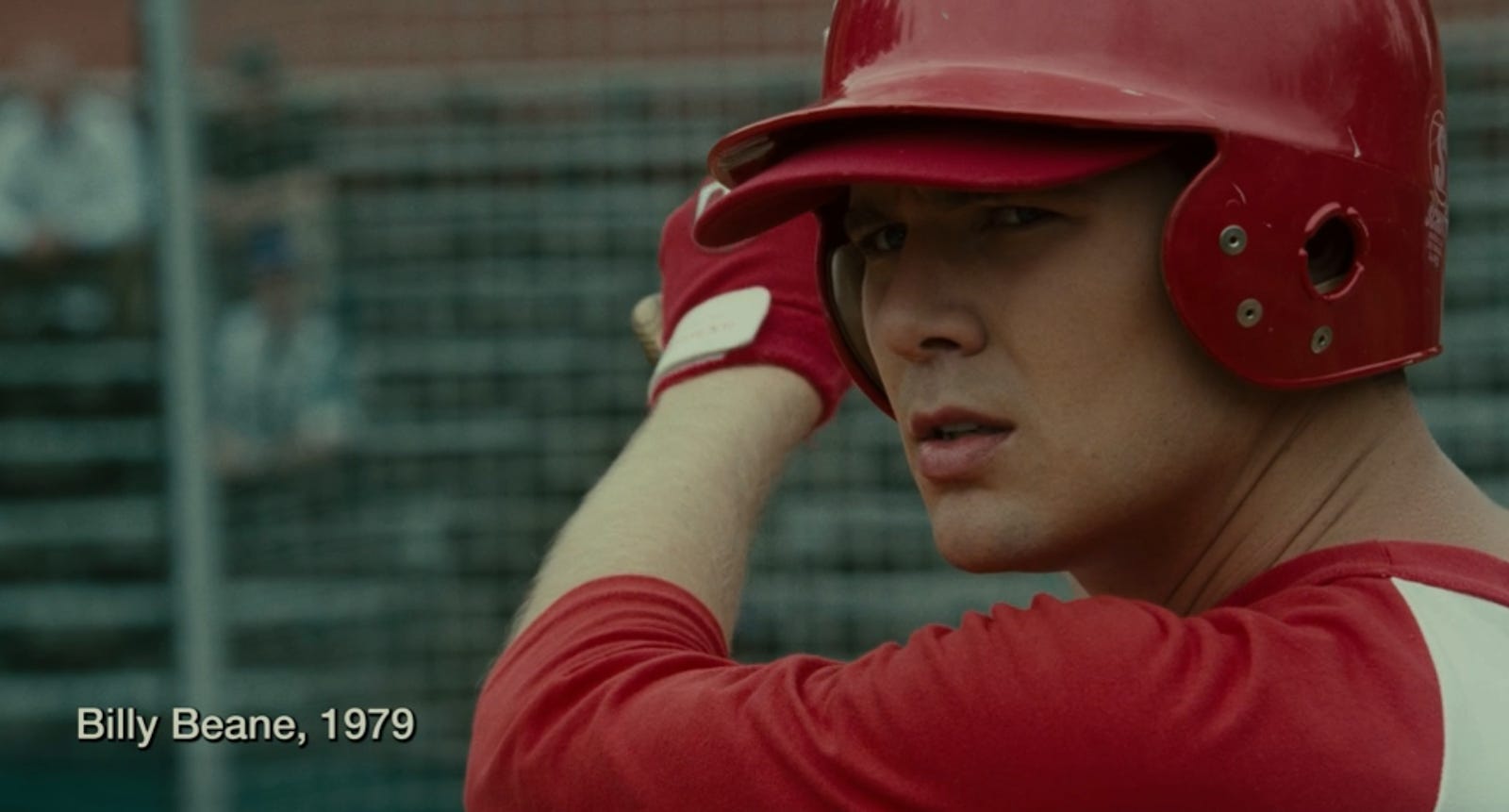
13:10: Part of the fun of Moneyball is how it blends (a) stuff that’s happening in the present; (b) flashbacks from the past of Billy Beane’s playing career, beginning with him being a first round draft prospect and ending with him flaming out a few years later; and (c) footage from actual baseball games. It all works in symphony to make Moneyball feel real in a way that no other sports movie ever has. There’s this sort of impossible-to-grab-a-hold-of ephemerality to it; an essence, if you will; a kind of diagnosis on the human condition via sports. Or something. I don’t know. Maybe I just like the somber piano keys and desolate wind sound effect they play during these flashbacks?

17:27: Jonah Hill is here. He plays Peter Brand, a Yale economics graduate with a radical idea to completely shift the way Major League teams identify value in players. This is a really wonderful performance from Jonah Hill. He’s subtle, and measured, and insular—and I’m just a big, big fan of it. I definitely like Loud, Ostentatious Jonah Hill the most (which is why his showing in The Wolf of Wall Street will always be the Jonah Hill Gold Standard for me), but he’s got a great knack for turning down the volume on everything and still being a presence on screen.

19:23: Here’s the money moment of the movie. Peter, who unintentionally impressed Billy during Billy’s trip to meet with the GM of the Cleveland Indians, is in a parking garage explaining what he believes to be a fundamental misunderstanding of any baseball player’s value. He tells Billy: “People who run ball clubs, they think in terms of buying players. Your goal shouldn’t be to buy players. Your goal should be to buy wins. And in order to buy wins, you need to buy runs.” Again: There’s absolutely no reason that this idea should make for a riveting movie, but it absolutely does.
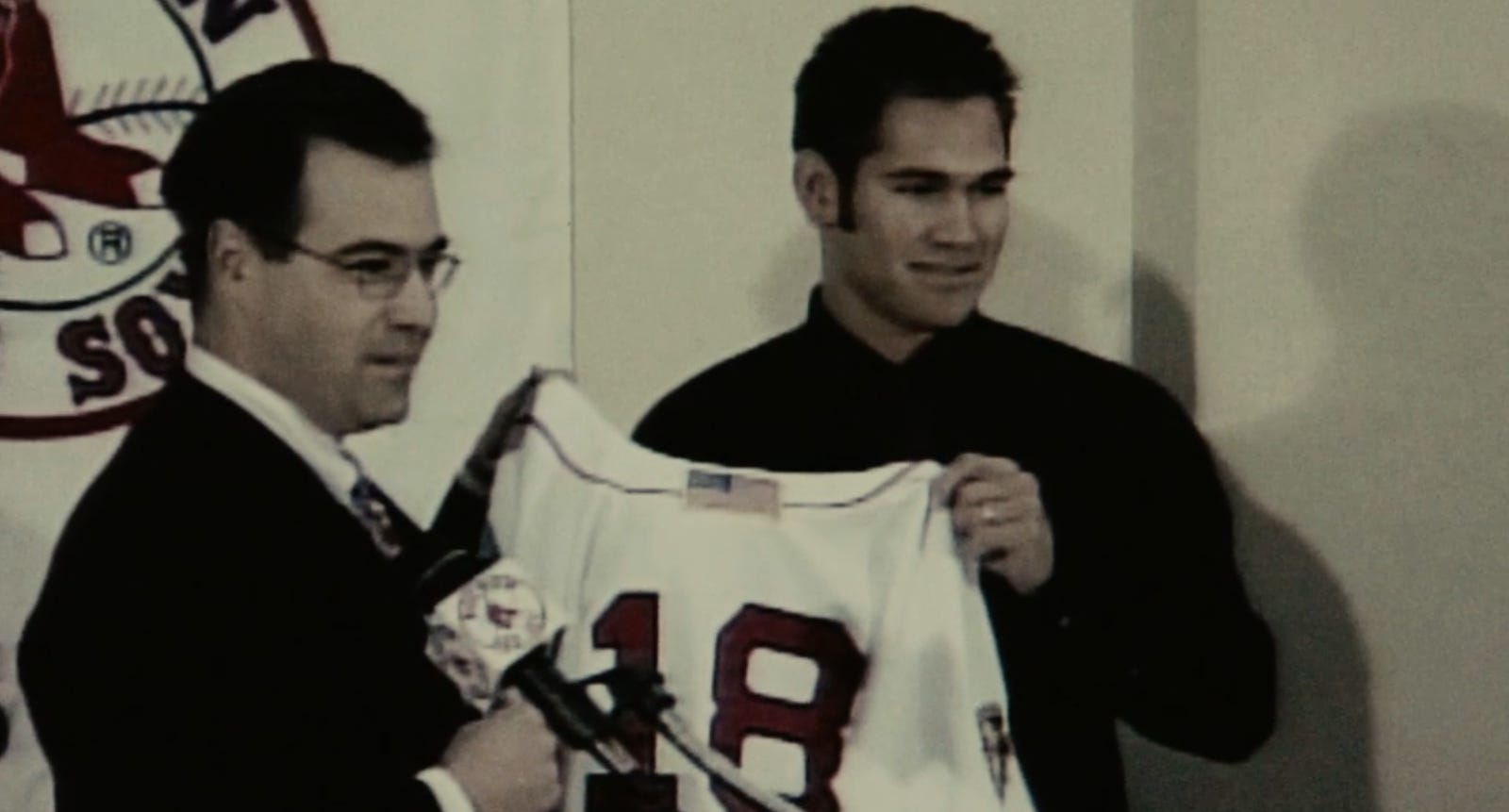
19:23: P.S. As part of his explanation, Pete spotlights Johnny Damon, a player the Red Sox were recently able to steal away from the Athletics by offering him a ton of money. (Billy is sad about losing Damon, but Pete says that it’s actually a good thing he’s gone.) While Pete is making his point, the movie cuts to footage of the real-life Damon accepting his Red Sox jersey. I bet poor Johnny Damon felt like the “What’d he say ‘fuck me’ for?” 50 Cent meme when he first watched this and realized Moneyball made him the official face of Inefficient Baseball.

24:01: When Billy calls Pete to tell him that he works for him now, he says, “Pack your bags, Pete. I just bought you from the Cleveland Indians.” It’s pretty crazy that we made it all the way to 2020 before the people in charge of Cleveland’s billion-dollar professional baseball team started listening to everyone who was like, “Hey, so, ummm… what do y’all think about not having a caricature of a Native American as your logo?”2

26:44: The score of this movie—crafted by Oscar-winning composer Mychael Danna—is great. It’s aspirational, but also it has an ache to it. That’s why everything that happens on screen while it’s playing feels so special, no matter how mundane, including Jonah Hill hooking a laptop up to a computer in the dark.
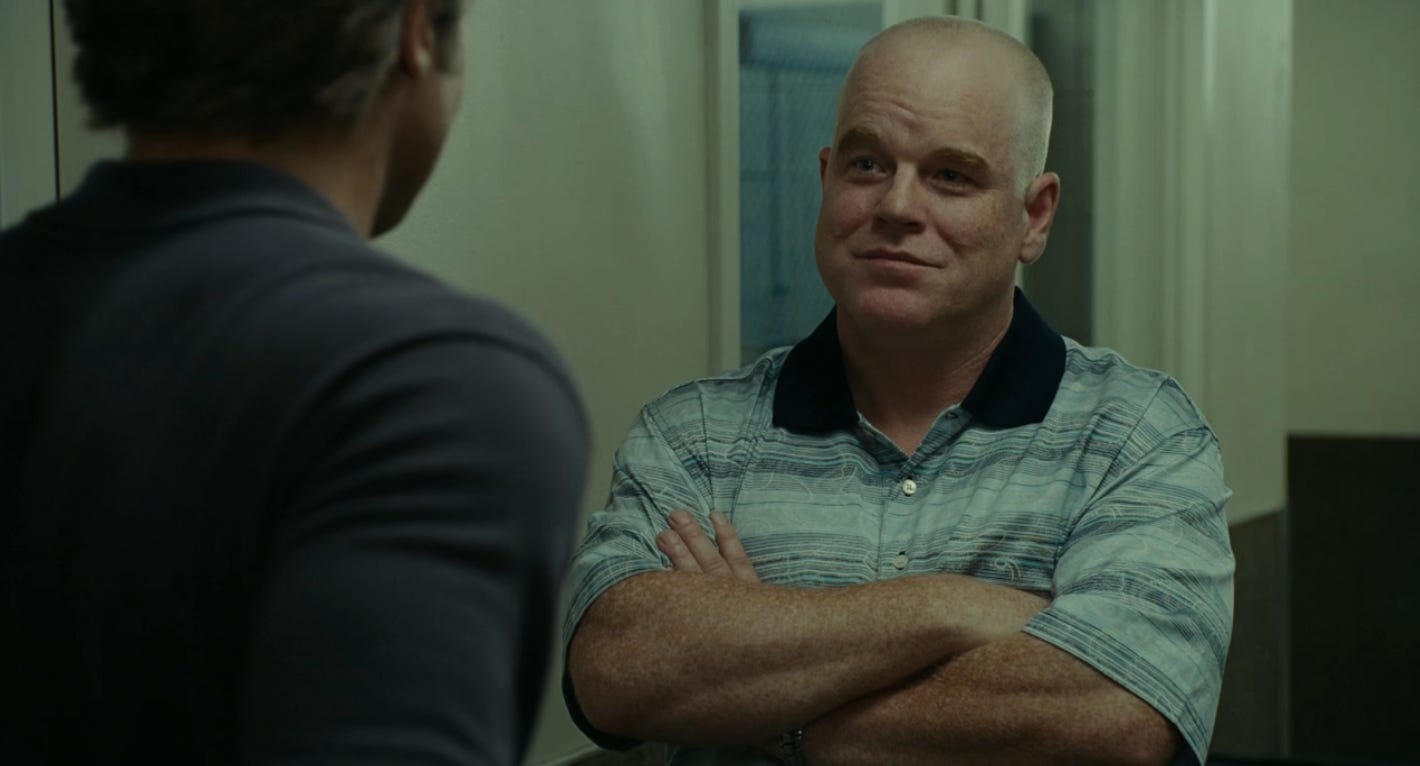
30:22: Philip Seymour Hoffman is here. He plays Art Howe, manager of the Oakland Athletics, and he’s absolutely perfect in this. The fact that there are eight or nine Philip Seymour Hoffman performances even better than this one is why so many people argue that he was the greatest actor of his generation.
30:23: P.S. The PHILIP SEYMOUR HOFFMAN’S INCREDIBLE PERFORMANCES podium:
The second honorable mention spot goes to his performance as Owen Davian in Mission: Impossible III. (The best villain the franchise has ever had.)
The first honorable mention spot goes to his performance as Dean Trumbell in Punch-Drunk Love. (I’m such a sucker for this movie, and also for the necklace PSH wears in it.)
The bronze medal spot goes to his performance as Lester Bangs in Almost Famous. (The coolest any writer has ever been in a movie.)
